
A Case For God's Existence Using Simulation Theory

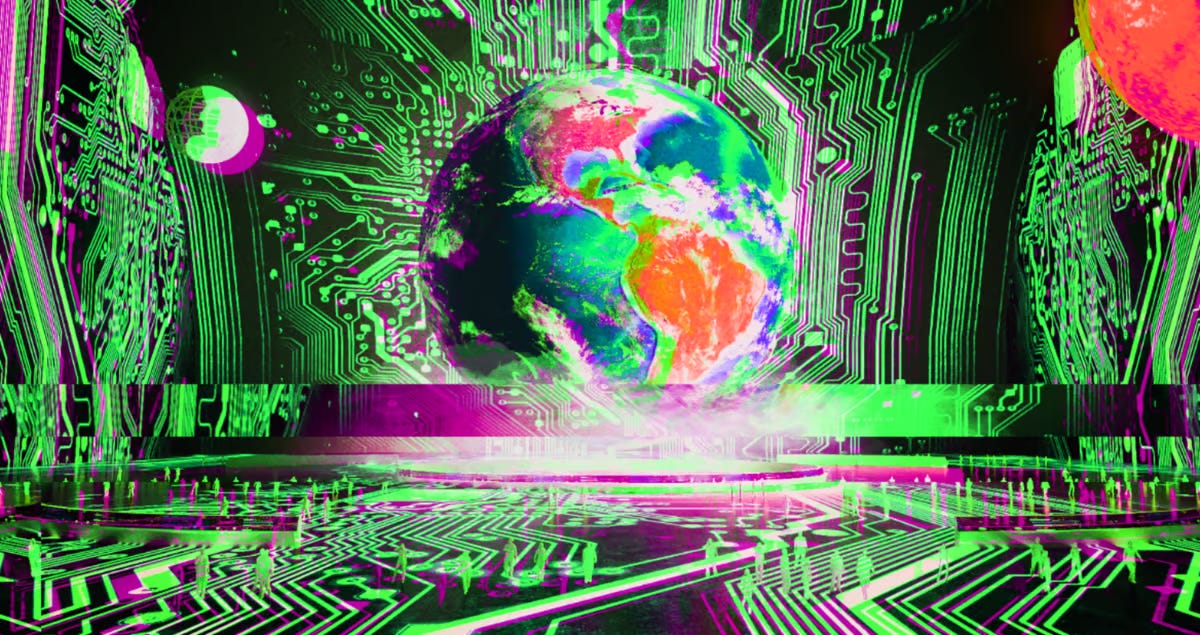
I’ll preface this by saying that I am not religious. At best, I’d calling myself a part-time philosopher playing with ideas. And those ideas can extend without any real restriction as a form of play. So today will be a brief dip into a discussion of God that has rattled around in my head for years.
Across religious faiths God, gods, deities or the divine itself manifest in varying forms. We have God of the Abrahamic religions, to Shiva the Destroyer or Anansi the trickster God and the namesake of this Substack.
For this discussion, I will define the highest level Godhood as the following:
All-knowing (Omniscient)
All-powerful (Omnipotent)
All-present (Omnipresent)
Transcendent (existing of beyond our physical universe — not bounded by time, space or matter)
A few gods fall under this classification, but listing them is not relevant to the discussion. Now, to simulation theory. While simulation theory is popular amongst sci-fi fans and technologists, it’s not what you immediately associate with religion. It’ll make sense, I promise.
Let’s imagine you and I developed a computer simulated universe. Let’s also imagine that there is a simulated version of Earth within this, with simulated humans living on it. Let’s also say that these simulated humans are all self-aware AI. They don’t know that they’re AI in a simulation — they believe that their existence is as real and concrete as our own. They have emotions, thoughts, fears and loves as vivid as our internal landscape is.
Regarding this simulated universe, it doesn’t have to be as complex and vast as ours. Let’s just say that it has rules in the form of physics like our universe, and it’s vast and complex enough for the simulated humans within it to not be able to understand its true nature.
With you and I as programmers of this simulated universe, we would have absolute power over it. Like having admin powers in a game like Minecraft, we could change the rules/physics of the simulation. We could conjure items or material into existence (or turn water into wine, maybe *wink wink*). If we had an avatar within this simulation (like you would in a video game) we would be able to violate the rules of the simulation, since we wrote it. Our “real” bodies would also not be subject to the rules or time within this simulation, since we exist outside of it.
In this sense, we would meet a definition of Godhood relative to the denizens of the simulation.
We would be all-knowing of the simulation (or close to it). We would be able to observe all aspects of the simulation, and perhaps even run it multiple times to understand every way it could play out.
We would also be all-powerful regarding the simulation. None of the rules of the simulation apply to us, and and we could manipulate it at will.
We could also be considered somewhat omnipresent. Our will would extend throughout the simulation and any avatar of us within the simulation could exist anywhere and everywhere.
Lastly, we would also be considered transcendent, since our real bodies exist outside of the simulation. Therefore, we would not be subject to the flow of time or the rules of physics within this simulation.
When this idea first bubbled up within my mind, it made me re-consider our interpretation of deities and Godhood, even beyond simulation theory. What if Godhood isn’t about a level of absolute power, but a level of relative power to another group/being/consciousness? What if God is just a programmer of a simulation? While nothing may change for us in our “base” version of reality, relative to those inside of a simulation, we’re gods.
Think of our relative power to ants. To ourselves, we’re just beings of flesh and bone, going about our daily lives. To an ant, a human is utterly incomprehensible and beyond any power they could muster.
You can extend this principle beyond simulation theory for some other interesting considerations. What if our conception of the universe only covers a minuscule part of all existence?
There have been some scientific theories (such as Eternal Inflation Theory) that posit that our universe might be a “pocket universe” in a broader universe. That is, just like a bubble emerges on the turbulent surf in the ocean, our universe could be a bubble in a broader fabric of reality.
If that’s the case, there could be higher or more broad levels of existence. Perhaps our entire universe could be observed or manipulated much like a simulation or a science experiment. What if our universe is just a physics experiment at a higher plane of existence?
Anyway, this piece is just play. This Substack is really meant to be a free-styling, wildcard approach to articles to philosophical ideas or thought experiments I find intellectually stimulating. Thanks for reading, until the next one :)